
Enabling Cost-Effective Mic Preamp Design with Enhanced HGC Features
Introduction
Modern audio systems demand precise and pop-free microphone preamp gain control over a wide gain range—while reducing system power, cost, and design complexity. Traditional digitally controlled mic preamp architectures often necessitate tradeoffs between wide gain range, fine gain resolution, optimal noise performance, and system design simplicity.
This article describes the enhanced HGC features presented in the Cirrus Logic CS4233S codec and CS5312S ADC devices and explains how these new features deliver a cost-effective solution for mic preamp designs, delivering professional audio-grade quality with fewer components, simpler system architecture, and greater design flexibility across a broad range of audio applications.
HGC Overview
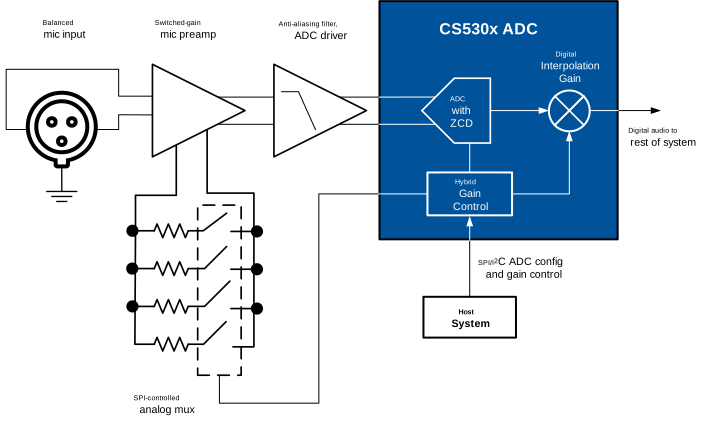
Hybrid Gain Control (HGC) —first introduced in the Cirrus Logic CS530x family of professional audio ADCs—enables fine-resolution mic preamp gain control with the feel of a traditional potentiometer, without audible pops or zipper noise. This is achieved by integrating adjustable mic preamp gain control into the ADC, together with zero-cross detection and precisely synchronized digital gain control, as discussed in the Cirrus Logic article “No Zipper, No Pop!". A simplified HGC system architecture is illustrated in Figure 1.
Enhanced HGC Features
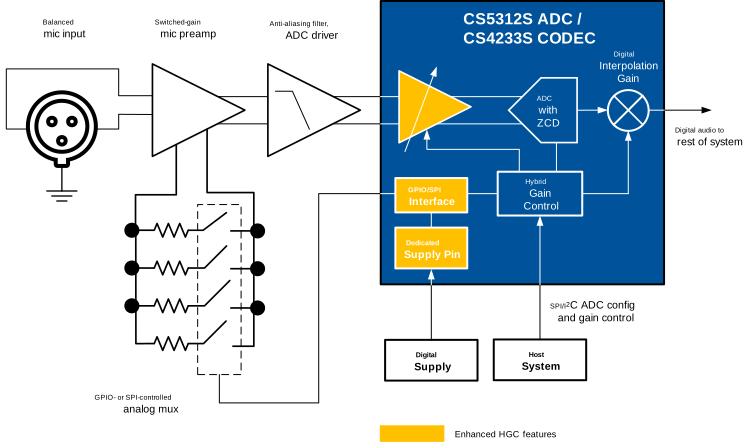
The enhanced HGC features offered by the CS4233S codec and CS5312S ADC build on this proven foundation of pop-free, digitally controlled gain transitions by integrating analog gain, providing an optional GPIO gain control interface, and adding an independent gain-control interface supply. These new features help reduce overall system BoM, while the CS530x devices remain an ideal solution for applications that call for higher audio performance. A simplified HGC system architecture including these features is illustrated in Figure 2.
Integrated Analog Gain
In a mic preamp, digital gain control is often implemented using analog multiplexers to switch different gain-setting resistors into the circuit; an example is shown in Figure 1 and Figure 2. This method selects a limited number of discrete gain settings, which are determined by the available analog multiplexers and switching resistors in the circuit.
This method presents a potential challenge for system design because a wide gain range is required to handle large variations in input signal level, while the limited number of steps inherently restricts fine gain control.
By integrating configurable analog gain into the ADC input path, the CS4233S codec and CS5312S ADC devices reduce system reliance on analog multiplexers and switching resistors to provide high dynamic range across the gain control range.
The configurable analog gain stage employs an input-capacitance scaling architecture, which reduces input-referred noise at higher gain settings by increasing sampling capacitance. This is demonstrated by the typical input-referred noise performance across different gain configurations of the CS4233S and CS5312S devices, as shown in Table 1.
| Parameter | Typ | Units | |
|---|---|---|---|
| Input-referred noise (A-weighted) | Internal analog gain = 0 dB | 3.55 | µVRMS |
| Internal analog gain = 6 dB | 2.51 | µVRMS | |
| Internal analog gain = 12 dB | 1.78 | µVRMS | |
Using the internal analog gain steps for the first interpolation stage improves dynamic range across gain—compared to digital interpolation gain and to resistor-based external gain setting circuits. With this architecture, the mic preamp provides coarse gain adjustments and the integrated analog and digital gain work together, minimizing peak interpolation digital gain to maximize overall dynamic range. With all gain changes synchronized by HGC, this approach enables pop-free gain control over a wider mic preamp gain range without compromising dynamic range, providing precise gain tuning with fewer components, while lowering system cost and simplifying the overall design.
Independent Gain-Control Interface Supply
Audio systems must often be designed to minimize power consumption. Analog multiplexers and switched-resistor circuits require a sufficient operating voltage to maintain noise margins; however, digital control circuits typically use a lower supply voltage to reduce power.
Traditionally, level-shifting circuitry is used to allow mixed operating voltages to be available in a system. However, adding level shifters increases system cost and complexity, and introduces additional points of failure.
In the CS4233S and CS5312S devices, a dedicated digital supply pin for gain control enables the host processor and the gain-control interfaces to operate at different voltage levels without requiring level shifters. By eliminating the need for level shifters, system cost and complexity are reduced, and overall system robustness is improved.
Choice of SPI or GPIO Gain-Control Interface
The CS530x family of devices includes a dedicated SPI gain control interface, ideal for supporting gain switching in systems where numerous external gain elements must be controlled using a minimal number of host pins. The CS4233S codec and CS5312S ADC provide a choice of SPI or GPIO interface for external gain control. Each interface offers advantages depending on the requirements of the application; for example, GPIO control may be more suitable for systems where fewer gain steps are required, and SPI control might be more appropriate for systems where many gain steps are required. By supporting both interfaces system designs can be optimized for scalability or for cost efficiency and design simplicity as required.
Conclusion
The enhanced HGC features included in the Cirrus Logic CS4233S codec and CS5312S ADC devices extend the benefits of HGC by more deeply integrating analog gain and digital gain within the mic preamp signal chain. Coordinating external and internal analog gain together with digital gain changes at zero-crossing points, enables wide, seamless, and pop-free gain adjustment while maintaining optimal headroom and improving signal-to-noise ratio across the full operating range. The higher level of integration reduces component count, simplifies system design, and reduces overall bill of materials. Additionally, an independent gain control interface supply pin and a choice of gain control interfaces enable mic preamp designs that are optimized for power consumption, scalability, and simplicity.
As a result, the enhanced HGC features in the Cirrus Logic CS4233S codec and CS5312S ADC devices enable cost-effective mic preamp designs that achieve professional-quality audio with reduced component count, streamlined system implementation, and increased design flexibility across diverse audio applications.